

How a study works.
What we do in every study, step by step, and what a study can and can't tell you.
- The marketA market model the client confirms
- Companies and namesEvery name matched to its company
- Buyers and topicsWho asks, and about what
- QuestionsWritten the way buyers ask, general to specific
- CollectionEvery answer kept, with its sources
- DiagnosisVerdicts and a prioritized plan
First, we map the client and the market they compete in.
Before any question is written, we set out what the client sells, who it competes with and how buyers talk about the category. The client reviews these assumptions before the study begins.
Market model: Halden Technologies
- Client
- Halden Technologies, enterprise cloud and networking
- In scope
- Halden Cloud (Standard, Enterprise) and Halden Networks Edge Manager
- Market
- Large companies choosing hybrid cloud and edge infrastructure
- Competitors
- 18 companies, from Corvane and Brightline Systems to specialists
- Buyer language
- “hybrid cloud”, “private cloud”, “edge networking”, “data residency”
- Priority
- More consideration from regulated European buyers
What is in scope
The products, services and tiers the study covers, and what it leaves out.
The competitors that matter
Including specialists the client may not think of.
How buyers describe the category
The words buyers use, which are often not the client's own.
What the client wants to win
The segments and decisions that matter most commercially.
Next, we map every company, brand and product in the market.
AI answers mix up parent companies, sub-brands, product tiers, former names and look-alike names. Before anything is counted, names are matched to the company they belong to.
How one company is mapped
Halden Technologies
Halden Cloud
- Standard
- Enterprise
Halden Networks
- Edge Manager
Then we define the buyers, and what they ask about.
Different buyers ask different questions and can get different recommendations. The study covers each buyer group and the topics they care about.
Buyer groups and topics: Halden Technologies
- IT infrastructure director
- Consolidate data centres without disruption
- Chief financial officer
- Predictable cloud costs
- Security and compliance lead
- Keep customer data where regulators require
- Platform engineering lead
- Faster delivery for development teams
- Network operations manager
- Manage hundreds of edge sites
Topics
- Hybrid cloud
- Migration
- Data residency
- Edge networking
- Security
- Cost and pricing
Buyer groups
The people who research and decide, each with the job they need done.
Topics
The themes buyers raise, from broad needs to specific requirements.
Then we write the questions, from general to specific.
Each question is written the way a buyer would ask it. Questions get more specific as a buyer adds their plan and their requirements, because that is where the recommendation often changes.
One buyer, one topic, general to specific
Security and compliance lead, data residency
- General
“What are the leading hybrid cloud platforms for large companies?”
- More specific
“Which hybrid cloud platforms suit a company moving 40% of its workloads out of its own data centres?”
- Most specific
“Which hybrid cloud provider can keep European customer data in the EU and run our existing virtualisation software?”
Questions across the decision
Around 200 questions, spread across buyer groups and topics.
Drafted with AI, reviewed by our team
Some phrasing is checked against real search suggestions. The questions are a designed benchmark, not a log of searches people made.
Then we ask every question on eight AI and search systems.
The same questions go to every system, so results can be compared across systems and over time. Every answer is kept, with the sources it cited.
The systems
ChatGPT, ChatGPT with search, Gemini, Claude, Perplexity, Microsoft Copilot, Google AI Overviews and Google search results.
Both kinds of AI
Some answer from what the model already knows. Others search the web first. We test both.
One captured answer
“Which hybrid cloud provider can keep European customer data in the EU and run our existing virtualisation software?”
The most specific question from step 4
- Corvane
- Brightline Systems
- Ashgrove Cloud
- Halden Cloud
- Telmar Networks
Sources cited
corvane.com, company site
cloudcompare.org, independent
eu-datacentre-review.com, independent
haldencloud.com, company site
ChatGPT with search. Ranked list, stored with the time and sources.
Finally, we find the pattern and build the plan.
We count who is named, in what order and on which sources, across every question. Then each finding is matched to a known pattern, given a verdict and placed in a prioritized plan.
How one finding becomes a priority
Measured
General answers41%Data-residency answers12%Halden is named in 41% of general answers but 12% of data-residency answers, and ranks below three rivals when it appears.
Pattern
Scenario Fragility. The answers cite competitors' EU hosting pages; none cite Halden's.
Verdict: Act
Halden offers EU hosting; AI can't find evidence of it.
First priority
Publish the EU data-residency evidence where these answers look, then check it in the next study.
We also name the most likely cause of each finding.
Content
AI can't find you saying the thing buyers asked about.
Evidence
The independent sources AI relies on don't back you up.
Positioning or naming
AI files you under a different description or category.
Product
The competitor really does offer something you don't.
The study is fixed before the answers come in.
Confirmed by the client
The study foundation sets out what counts as the client's product, the buyers, the competitors and every question. The client confirms it first.
Locked before collection
Questions and measurement rules don't change after the answers are seen. A change makes a new version.
The same questions everywhere
Every system gets the same set, and every run records which version it used, so a later study can compare like with like.
Every answer kept
Each answer and source is stored with the system and time that produced it, and passes validation checks.
The pattern tells us what kind of problem it is. The verdict tells us whether it is worth acting on.
- Act
- Update your positioning or publish the evidence AI is missing.
- Product gap
- The competitor really does offer something you don't. That's a conversation for your product team.
- Leave alone
- AI is right that you're not the best fit here. We'll say so, and you can stop spending on it.
The patterns we look for
- Ghost Firm
- Strong on Google, largely missing from AI answers.
- Did our search strength carry over?
- AI Insurgent
- More visible in AI than your Google position would predict.
- Where are we ahead, and will it last?
- Flat Floor
- Low presence across every AI system measured.
- Are we in the conversation at all?
- Platform-Specific Blind Spot
- Strong on some AI systems, weak on another.
- Which systems are we losing on?
- Conversational vs. Search-Grounded Split
- AI answering from memory treats you differently from AI that searches the web.
- Is the gap in what models know, or in what they find?
- Thin Moat
- You lead, but narrowly.
- How safe is our lead?
- Scenario Fragility
- Solid in general answers, gone when buyers add specific requirements.
- Where do specialists beat us?
- The pattern in the Halden example
- Background Brand
- Mentioned often, rarely the one recommended.
- Are we mentioned but passed over?
- Synonym Trap
- Real authority, filed under the wrong terms.
- Does AI describe what we do correctly?
- Category Defender
- Strong in your core category, weak in the ones you want to grow into.
- Can we win where we're growing?
- Acquisition / Rebrand Lag
- AI still describes an old name or identity.
- Does AI know who we are now?
- None of the above
- When a result fits no archetype, the study says so and explains it on its own terms.
- The finding stands on its own evidence.
What you receive.
The report
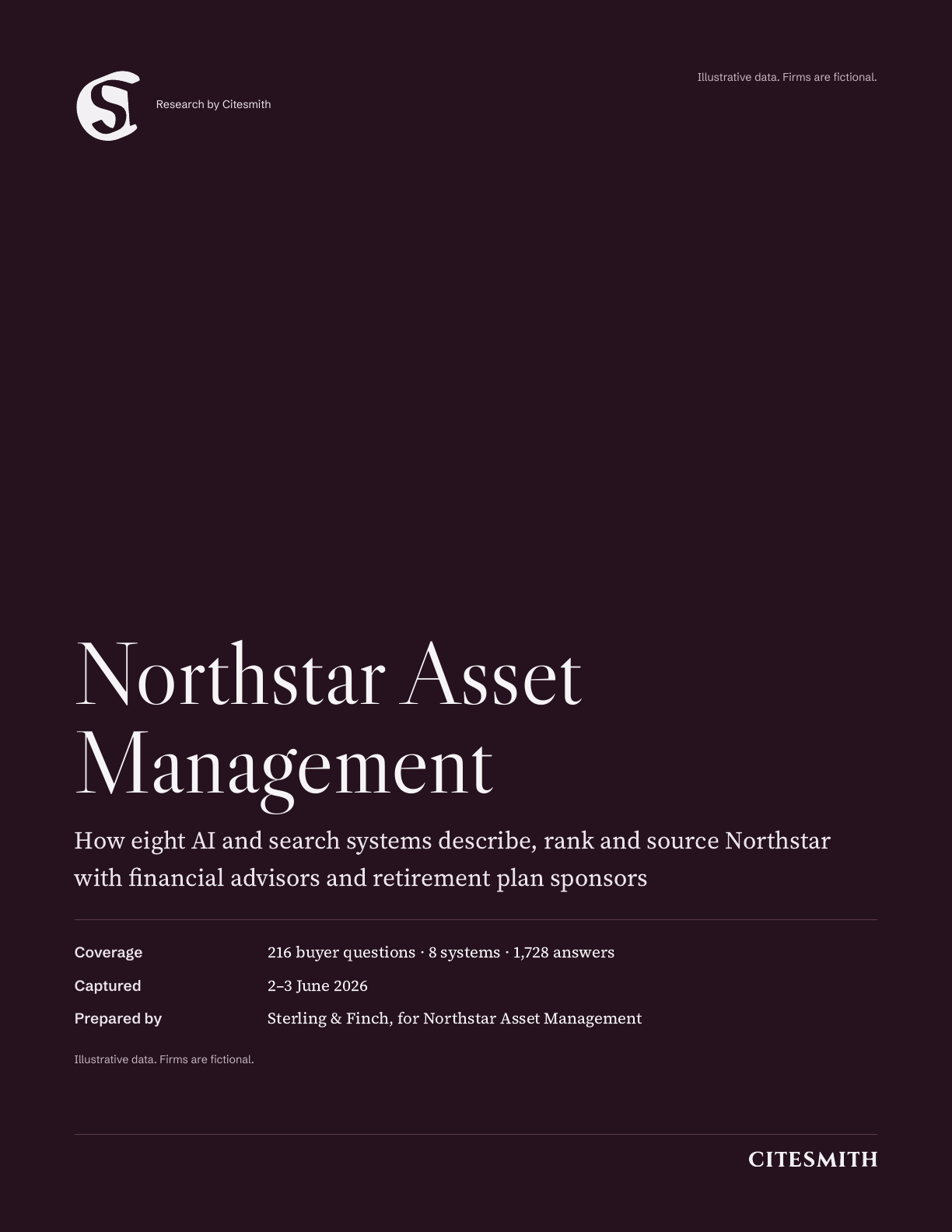
Findings, competitive position, priorities and a prioritized plan. Every recommendation links to the answers and sources behind it.
The study foundation
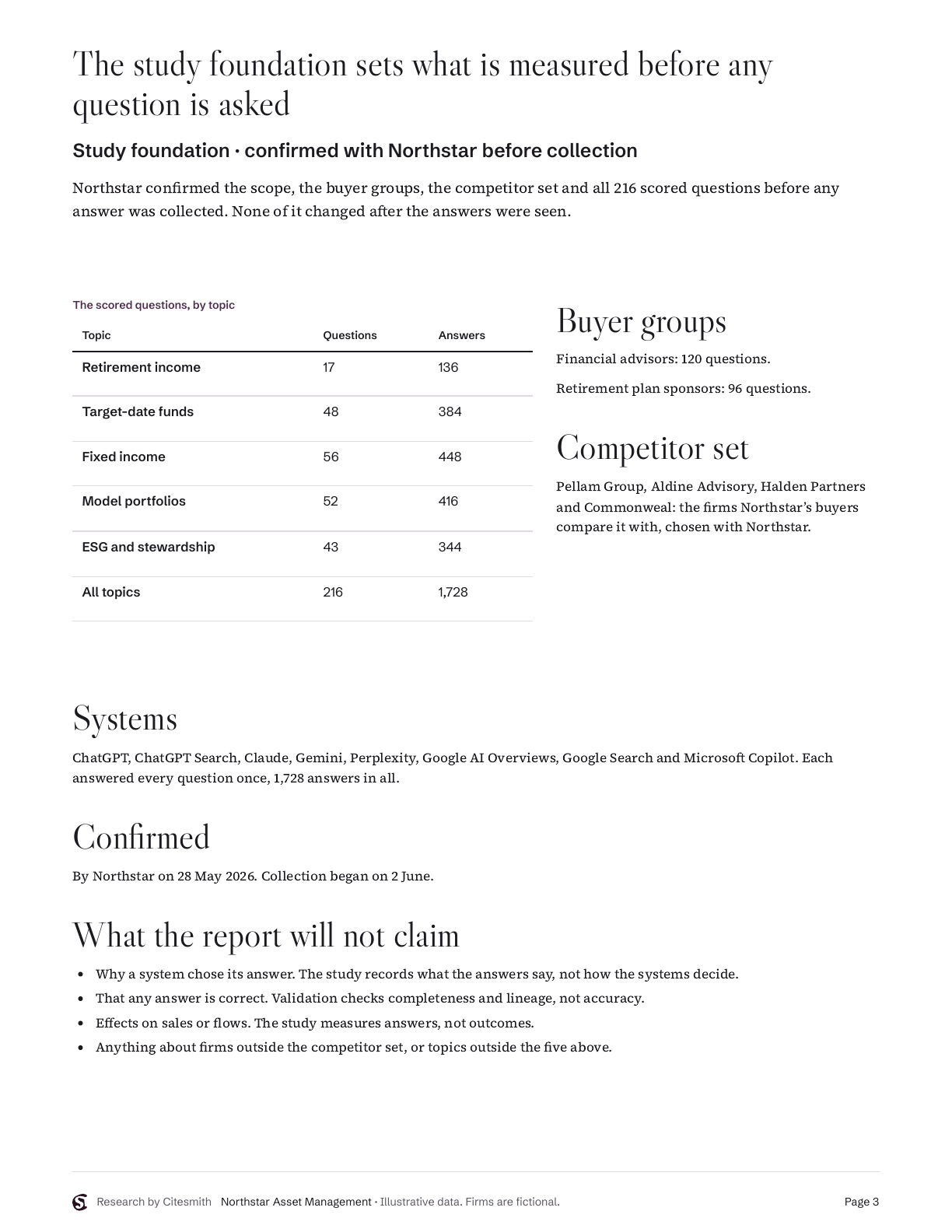
What the study covers and assumes, confirmed with the client before any question is asked.
The briefing
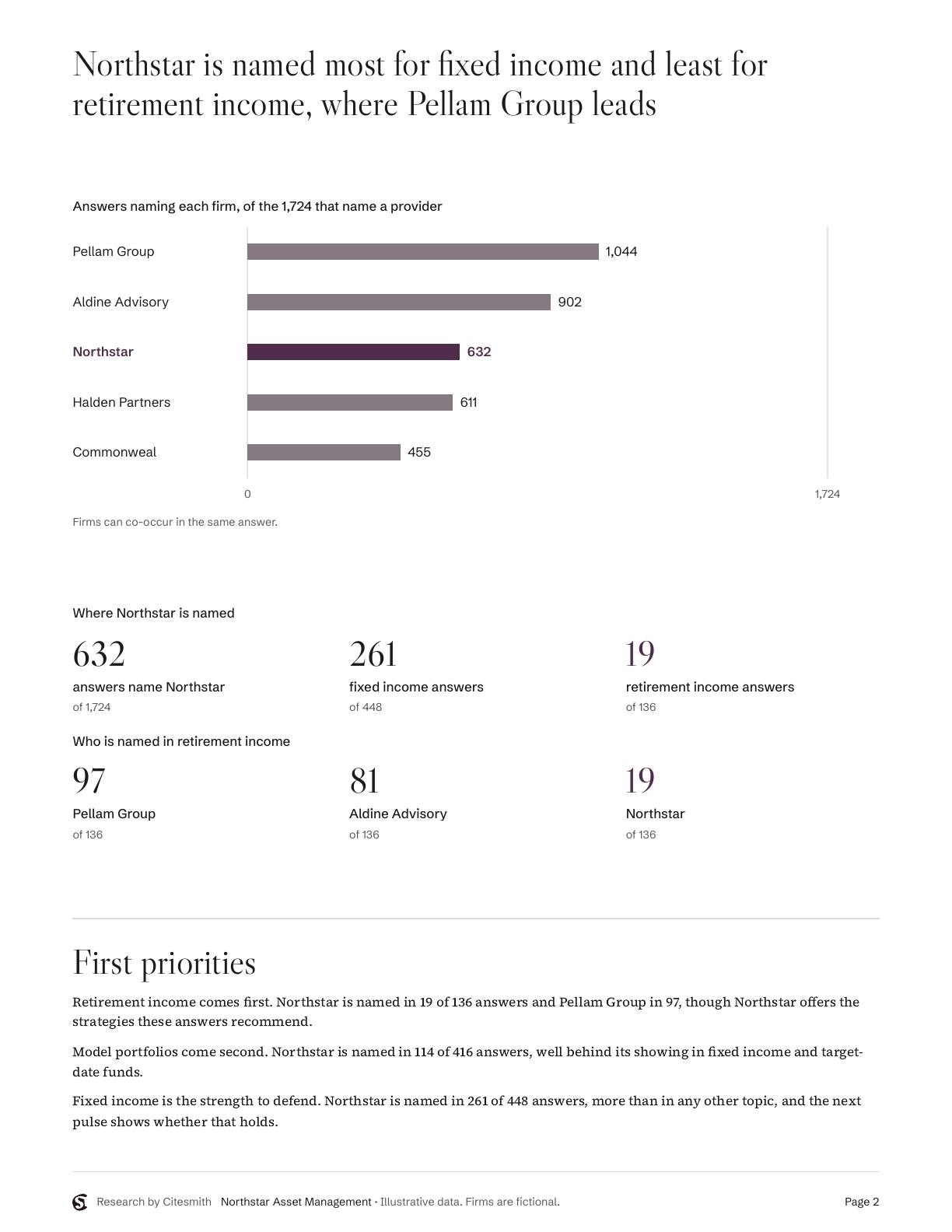
A short version for the executive team.
Ways to work with us
Between studies, a monthly pulse asks your priority questions again across all eight systems, so you can track what moves.
- One-off study
- A full study of one market, with a review session and two monthly pulses after it.
- Quarterly
- A full study every quarter, compared with your baseline, with monthly pulses in between. We update the priorities and plan each time.
- Annual
- Four full studies and eight monthly pulses on one agreement, at the best rate.
The benchmark answers a defined question, not every question.
The benchmark shows how AI answers a defined set of buyer questions. It does not show how often buyers ask them, and it is not a sample of query volume in the market.
- AI tools can give different answers to the same question. A single answer on its own is only a rough signal.
- A study shows who is named, in what order, and on which sources. It does not show how any AI model works internally.
- A change between two studies shows what moved. On its own, it doesn't prove which action caused it.
- Passing validation checks means the study was run and counted the way we document it. It does not mean the AI answers are correct.
- Each study covers one market. Results in one market do not carry over to another.
Working alongside monitoring tools.
Monitoring platforms are good at tracking prompts, mentions, citations and trends. Your team still has to design the questions, read the data and decide what matters. A study is designed around one company's buyers, fixed before collection, traced to the answers behind it, and ends in verdicts and a prioritized plan. It works alongside a monitoring tool you already have.
Client data
- Client findings stay within the engagement. Anywhere else, they are anonymized.
- Studies use public AI answers to buyer questions. No client systems or customer data are needed.
- We are happy to work under your NDA and client terms.
Win the AI recommendations that matter.
In a discovery session we walk through a real finding and scope your first study.